sales@yhywiremesh.com
Whatsapp :+86 15027768227



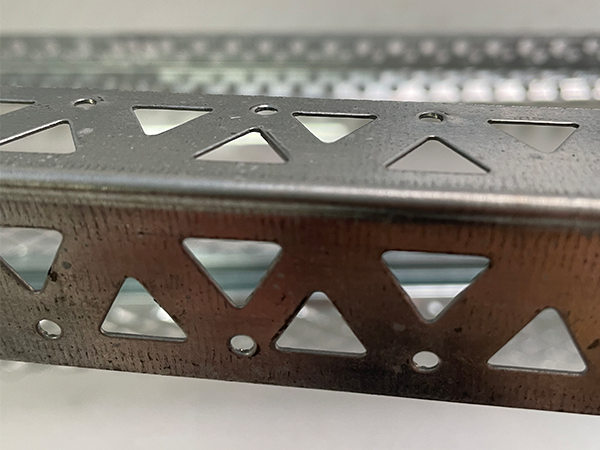
The core advantage of perforated corner beads lies in their use of a thin, perforated metal profile to address several key pain points associated with traditional corner reinforcement methods (such as standard corner bars or angle irons): poor bonding, a tendency for the plaster to delaminate (hollow out) or crack, and a heavy reliance on the manual skill of workers to achieve a straight edge. Essentially, these beads act as a "reinforcing mesh" embedded within the plaster layer—relying on mortar that penetrates the perforations to create a mechanical interlock—rather than serving as a rigid "outer shell" that resists impact solely through its own thickness.
Advantage 1: "Mechanical interlock" via perforations—fundamentally preventing delamination and cracking
This is the most essential advantage of perforated corner beads and what distinguishes them from solid (non-perforated) angle irons. During application, the plaster mortar passes through the holes in the bead and extrudes outward; once it sets, the mortar and the bead are no longer merely "attached" to one another—they are physically anchored and interlocked. This mechanical bond integrates the corner bead into the plaster layer, effectively resisting delamination and cracking along the corner caused by temperature fluctuations or minor structural shifts. Its adhesion is far superior to that of smooth, non-perforated materials.
Advantage 2: Significantly increased construction efficiency and reduced reliance on manual craftsmanship
Traditionally, achieving a perfectly straight corner during plastering relies heavily on the skill of the worker and the use of straight-edges—a process so demanding that workers often say, "I’d rather plaster an entire wall surface than try to get one corner perfectly straight." A perforated corner bead serves as a pre-formed, right-angled framework; once fixed to the corner, workers simply apply the plaster as usual, allowing the mortar to squeeze through the holes before leveling it off. The straightness and flatness of the external corner are guaranteed by the bead itself, eliminating the need for repetitive, manual alignment. Reports indicate that using these corner beads can accelerate construction by two to three times compared to traditional methods, significantly shortening project timelines and lowering labor costs.
Advantage 3: Acute-angle design and resilient material—dispersing impact rather than resisting it through rigidity
Perforated corner beads are typically designed with an acute angle—slightly less than 90 degrees. When a corner is struck, this design helps distribute the concentrated impact force toward the adjacent surfaces, rather than allowing stress to accumulate at the outermost edge; this significantly reduces the likelihood of the corner chipping or cracking. Furthermore, the inherent toughness of the galvanized steel or aluminum alloy—combined with the surrounding layer of plaster—absorbs a portion of the impact energy, enabling the corner to withstand routine bumps without sustaining damage.
Advantage 4: Thin-walled galvanized construction—combining corrosion resistance with a design that maintains the intended plaster thickness.
Most standard perforated corner beads are manufactured from hot-dip galvanized steel with a thickness typically ranging from 0.3 mm to 0.5 mm. Being much thinner than traditional angle iron, these beads do not significantly increase the local thickness of the plaster layer. This prevents the formation of unsightly bulges at the corners—a common issue with thicker corner guards—and eliminates the need for additional leveling work. The hot-dip galvanized coating provides reliable rust protection, ensuring long-term performance stability in typical indoor and outdoor environments.
 Previous:
What is a storage cage?
 Next:
None


Copyright ©
ANPING YING HANG YUAN METAL WIRE MESH CO., LTD. All Rights Reserved | Sitemap Technical Support: