sales@yhywiremesh.com
Whatsapp :+86 15027768227



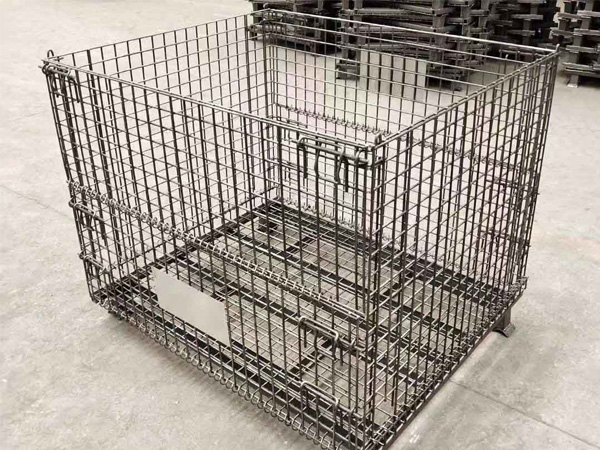
Storage cages—also known as warehouse cages or "butterfly" cages—are essential logistics containers used in warehousing and transportation. They offer numerous advantages, including fixed storage capacity, neat stacking, clear visibility of contents, and simplified inventory management, all while maximizing the effective use of warehouse space. These cages are designed to be collapsible, allowing them to be folded and stored away when not in use, thereby saving valuable warehouse space.
Features of Storage Cages:
1. Constructed from high-quality, cold-rolled, hardened steel, offering high strength and a large load-bearing capacity.
2. Standardized specifications and fixed capacities ensure that stored goods are easily identifiable, facilitating inventory checks.
3. Galvanized surface finish provides an attractive appearance, oxidation resistance, and a long service life.
4. Designed to international standards, they are compatible with shipping containers, effectively improving space utilization.
5. Can be stacked up to four units high, enabling three-dimensional storage.
6. Environmentally friendly surface treatment; hygienic and safe for use, with no risk of pollution during handling, storage, or recycling.
7. Compatible with equipment such as forklifts, pallet jacks, lifts, and cranes, enabling highly efficient operations.
8. Collapsible structure ensures low return/transport costs; serves as an ideal alternative to wooden crates.
9. Can be fitted with casters at the base, making them highly convenient for internal factory transport.
Functions of Storage Cages:
(I) Storage cages are a primary means of enhancing the efficiency of a warehousing system. A robust warehousing system relies on the application of modern storage equipment. The development of new storage equipment has made a significant contribution to the advancement of modern warehousing. Experience has shown that advanced storage equipment and sophisticated warehouse management are the two pillars—or "wheels"—that drive the rapid development of modern warehousing; both are indispensable.
(II) Storage cages represent a major cost factor in the construction of a warehousing system. Modern storage equipment is a capital-intensive asset. The initial investment required to procure such equipment is substantial. Furthermore, maintaining the system’s smooth operation and maximizing equipment performance requires ongoing, significant financial investment. The cost of warehousing equipment significantly influences the input-output analysis of a system. Such equipment serves as a primary indicator of the sophistication level of a warehousing system.
Warehousing equipment is intrinsically linked to warehousing activities. Throughout the entire warehousing process, various operational functions—including storage and safekeeping, inventory duration control, quantity management, quality maintenance, and other auxiliary tasks—are performed. The efficient execution of these tasks requires specific types of warehousing equipment. Consequently, the caliber of this equipment directly affects the comprehensive and effective realization of all warehousing functions, and ultimately determines the technical sophistication of the logistics system.
 Next:
None


Copyright ©
ANPING YING HANG YUAN METAL WIRE MESH CO., LTD. All Rights Reserved | Sitemap Technical Support: