sales@yhywiremesh.com
Whatsapp :+86 15027768227



In production environments such as mining (sand and gravel), coal washing, and building materials processing, many enterprises face a common challenge: standard screen meshes quickly suffer from clogging and blinding.
When damp fines become wedged in the apertures or sticky materials adhere to the screen surface, screening efficiency plummets. Production lines are forced to shut down repeatedly for manual cleaning, consuming labor hours, disrupting continuous production, and resulting in lost capacity and increased hidden costs. Anti-clogging screens are specialized screening products developed specifically to address these operational pain points.
What is an anti-clogging screen?
An anti-clogging screen is not a single specific product but a general term for a category of screens capable of preventing clogging.
Unlike traditional screens with fixed apertures, these screens utilize three key strategies—optimized aperture geometry, specialized material selection, and dynamic self-cleaning designs—to minimize particle wedging and material blinding during vibration. They keep apertures clear over the long term, making them suitable for complex material conditions involving moisture, clay content, and fine powders.
Mainstream products on the market fall into two categories:
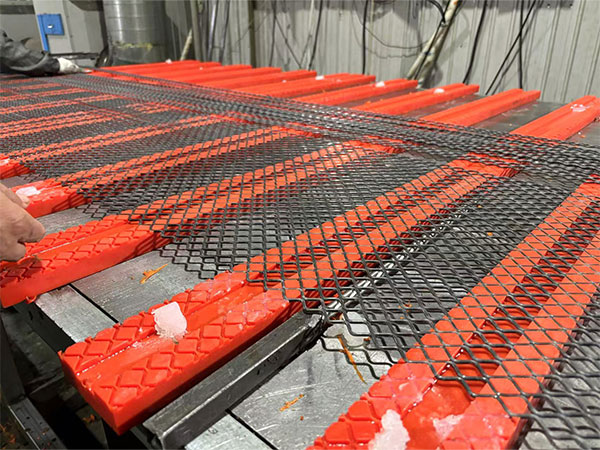
1. Metal anti-clogging screens (manganese steel/stainless steel): Featuring diamond, wavy crimped, or piano-wire structures, these offer high strength and impact resistance, making them ideal for heavy-duty applications like mining, sand and gravel, and raw coal processing.
2. Polyurethane anti-clogging screens: Featuring elastic apertures that allow for slight wire vibration, these are moisture- and wear-resistant; they are designed for highly adhesive or wet materials to reduce the likelihood of material sticking.
Core Principle: Why they resist clogging
✅ Special variable-diameter aperture shapes
Diamond, trapezoidal, and wavy aperture designs feature a wider top and narrower bottom, preventing materials from becoming wedged. During equipment vibration, the screen wires undergo slight deformation, shaking loose any particles trapped in the holes to achieve passive self-cleaning. ✅ Enhanced Material Properties
High-strength manganese steel offers impact resistance, while the smooth stainless steel surface minimizes adhesion. The inherent elasticity of the polyurethane prevents material from sticking or blinding the mesh, offering distinct advantages in damp operating conditions.
✅ Synergistic Vibration Performance
Leveraging the vibrating screen's excitation force, the mesh wires undergo secondary oscillation. This action breaks up fine powder agglomerates and prevents material adhesion, eliminating the need for frequent shutdowns to manually clear the screen surface.
Four Key Advantages:
???? Increased Screening Efficiency & Higher Throughput
Significantly reduces blinding rates and maximizes the effective open area of the screen surface; production line throughput can increase by 20–30%, resulting in more consistent product sizing.
???? Reduced Downtime & Lower O&M Costs
Eliminates frequent shutdowns for mesh cleaning and reduces manual tasks like hammering or brushing; ensures greater production continuity and significantly cuts productivity losses caused by downtime.
???? Wear Resistance & Durability
Mesh blinding causes localized stress concentrations that accelerate wear and breakage; the anti-blinding structure minimizes localized abrasive wear, resulting in a significantly longer service life compared to standard screens.
???? Suitable for Challenging Conditions
Highly adaptable to materials that typically cause severe blinding on standard screens, such as damp sand and gravel, clay-rich ore, run-of-mine coal, tailings, and fine powders.
Key Application Sectors
• Mining & Aggregates: Screening of manufactured sand and river stone aggregates; handles muddy or damp stone effectively, preventing stones from jamming holes and stone dust from blinding the mesh.
• Coal Preparation: Classification and dewatering of run-of-mine coal; prevents damp coal from sticking to or blinding the mesh.
• Metallurgy & Building Materials: Ore classification and sintering material screening; ensures uniform feed particle size.
• Tailings & Environmental Protection: Tailings dry stacking and dewatering screening; performs exceptionally well with high-fines content.
• Powder Processing: Classification of specific fine powders; mitigates mesh blinding caused by static electricity. Tips for Selection and Avoiding Common Pitfalls
1. Anti-clogging screens are not a "cure-all." When selecting, prioritize factors such as material moisture, particle size, clay content, and equipment model to ensure the aperture shape and material are a proper match.
2. Metal screens are suitable for large particles and heavy impact; for moist, sticky materials, prioritize polyurethane anti-clogging screens.
3. When selecting aperture sizes, allow for a margin and choose based on actual material granularity; do not simply copy specifications used for standard screens.
4. Ensure proper tensioning during installation; insufficient tensioning weakens the vibration effect that prevents clogging, thereby compromising actual performance.
While screens may appear to be minor components of a production line, they directly impact the output of the entire system.
Many factories focus solely on the unit price of screens, overlooking the production losses caused by downtime due to clogging. Selecting an anti-clogging screen tailored to specific operating conditions is more than just an equipment upgrade—it optimizes the efficiency of the entire production line. It reduces the need for frequent replacements and cleaning-related shutdowns, ultimately lowering costs and boosting efficiency.
 Previous:
What is deformed steel rebar mesh?
Previous:
What is deformed steel rebar mesh?
 Next:
None
Next:
None


Copyright ©
ANPING YING HANG YUAN METAL WIRE MESH CO., LTD. All Rights Reserved | Sitemap Technical Support: