sales@yhywiremesh.com
Whatsapp :+86 15027768227



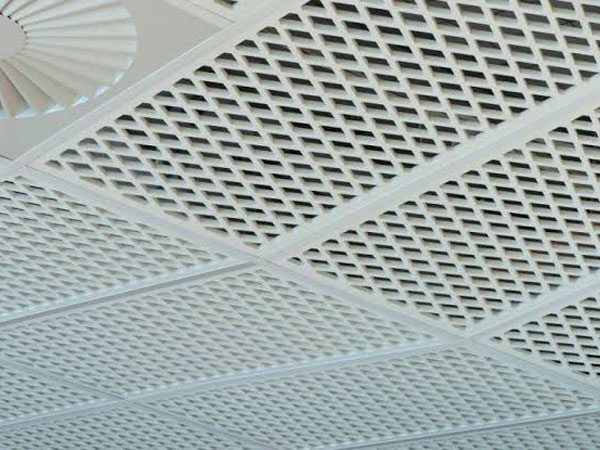
In the context of ceilings for shopping malls and office buildings, the term "expanded mesh"—often referred to in the industry as "aluminum expanded mesh"—denotes a metal decorative material created by slitting and stretching aluminum alloy sheets to form a mesh pattern. While "ceiling mesh" is a broader category, aluminum expanded mesh is the most widely used and best-suited type for interior ceiling applications.
Aluminum expanded mesh has become a mainstream choice for ceilings in commercial spaces for the following reasons:
* **Lightweight yet high-strength, reducing structural load:** Aluminum has only one-third the density of steel. For instance, at a thickness of 1.2mm, aluminum expanded mesh weighs approximately 3.2 kg per square meter, compared to 5.8 kg for steel mesh of the same specifications. For large-scale ceiling installations in shopping malls and office buildings, this significantly lowers the load-bearing requirements for the supporting framework (grid system) and the building structure itself, thereby saving on reinforcement costs.
* **Visually open and aesthetically pleasing, enhancing spatial quality:** The open-mesh structure creates dynamic light and shadow effects, mitigating the sense of confinement often associated with large, solid ceiling surfaces and making the space feel taller and more airy. Furthermore, it effectively conceals overhead elements—such as fire sprinkler piping and HVAC equipment—striking a balance between aesthetics and functionality.
* **Practical and easy to maintain:** The mesh design ensures excellent ventilation, which is particularly beneficial for high-traffic areas like shopping malls. Additionally, the modular installation method facilitates convenient access to equipment located above the ceiling, allowing for maintenance without the need for extensive dismantling.
* **Fire-resistant, moisture-proof, and durable:** Made from aluminum alloy, the material is inherently rust-proof and colorfast, with superior moisture resistance. With appropriate surface treatment, it can easily meet Class A fire safety standards, satisfying the regulatory requirements for commercial spaces.
Expanded Aluminum Mesh vs. Expanded Steel Mesh:
Key Differences: In addition to expanded aluminum mesh, expanded steel mesh (including galvanized steel and stainless steel) is another common option; however, they possess distinct characteristics:
Expanded Aluminum Mesh (Aluminum Alloy)
· Weight: Extremely lightweight—approximately 3.2 kg/m² (at 1.2 mm thickness)—making it favorable for building structures.
· Corrosion Resistance: Inherently rust-resistant with no additional treatment required; particularly well-suited for humid environments.
· Formability/Mesh Patterns: Excellent; capable of being processed into complex, intricate patterns such as hexagonal or fish-scale shapes.
· Strength/Load-Bearing Capacity: Tensile strength is approximately 100–200 MPa; lower load-bearing capacity, making it ideal for purely decorative ceilings.
· Typical Applications: Large-scale ceilings in shopping malls, office buildings, airports, and other spaces where aesthetics and low weight are prioritized.
Expanded Steel Mesh (Low-Carbon Steel/Galvanized Steel)
· Weight: Relatively heavy—approximately 5.8 kg/m² (at 1.2 mm thickness)—placing higher demands on the supporting framework (grid/joists).
· Corrosion Resistance: Requires surface treatment (such as powder coating or galvanizing) to prevent rust; otherwise, it is prone to corrosion.
· Formability/Mesh Patterns: Moderate; generally limited to standard patterns like diamond or square shapes.
· Strength/Load-Bearing Capacity: High strength, robust, and durable, with strong load-bearing performance.
· Typical Applications: Industrial-style ceilings requiring higher load-bearing capacity, protective fencing, partitions, etc.
 Next:
None


Copyright ©
ANPING YING HANG YUAN METAL WIRE MESH CO., LTD. All Rights Reserved | Sitemap Technical Support: