sales@yhywiremesh.com
Whatsapp :+86 15027768227



Barbed wire is a linear protective barrier manufactured from high-quality, low-carbon steel wire using an automated twisting machine. Its primary function is to provide isolation and security. Surface treatments include electro-galvanizing, hot-dip galvanizing, and PVC coating, which can result in various colors such as blue, green, or yellow. There are three main twisting methods: "standard twist" (two or more wires are twisted into a strand, around which the barbs are wrapped), "reverse twist" (barbs are wrapped around a single main wire, which is then twisted together with another wire), and "combined twist" (where the wire sections around the barbs are twisted in alternating directions). A specialized variant, razor wire—which incorporates high-strength steel wire with sharp, blade-like barbs—is specifically designed for high-security environments such as military bases and prisons.
I. Security and Protection: Establishing Robust Barriers Across Diverse Environments
In these contexts, the focus is on preventing unauthorized entry, deterring dangerous activities, and ensuring the safety of facilities and personnel—spanning both public and private spheres.
Along national land borders, dense, multi-layered barbed wire barriers are often deployed in conjunction with sensors and surveillance systems. These serve both as a clear demarcation of sovereign territory and as a primary line of defense against illegal border crossings, effectively impeding intruders and buying time for patrol and response teams. Around restricted military zones and sensitive, classified sites—such as military bases, ammunition depots, and radar stations—barbed wire serves as a standard security feature. It provides a clear, visual warning that entry is strictly prohibited, acting as the first line of defense for these critical areas.
In the judicial sector, barbed wire is installed atop the high walls and within the perimeter buffer zones of prisons and detention centers. It functions as a vital physical barrier that hinders escape attempts by inmates; its deterrent effect far exceeds that of a conventional wall, providing a solid foundation for the security and stability of these facilities. For high-risk facilities, such as power plants and substations, barbed wire fencing serves as an effective barrier against the unauthorized entry of individuals—particularly children or curious passersby—thereby preventing serious safety incidents like electric shocks at the source. For critical infrastructure essential to public life, such as telecommunications base stations and water treatment plants, barbed wire helps deter deliberate vandalism, preventing service disruptions like communication outages or water supply failures.
Regarding private and community security, barbed wire can be installed atop perimeter walls for homes or estates in remote areas to deter potential intruders and safeguard privacy and property. In residential communities, adding barbed wire to perimeter fencing further strengthens security and enhances protection against illegal entry.
II. Resource and Property Rights Protection: Safeguarding Assets and Boundaries
In these contexts, barbed wire functions primarily as a physical barrier to secure resources and assets, clearly define property boundaries, and minimize disputes over rights and interests.
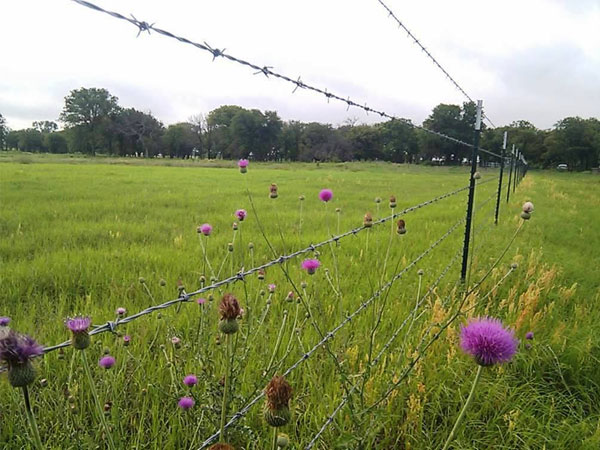
The protection of pastures is the traditional application for barbed wire; it offers a cost-effective method for enclosing large areas, preventing livestock—such as cattle, horses, and sheep—from straying, while also providing a degree of defense against wild predators like wolves. Within a pasture, it can also be used to separate different types of livestock or delineate rotational grazing zones, facilitating scientific livestock management. In agriculture and forestry, barbed wire installed around farmlands protects crops from being consumed or trampled by wild animals like boars and deer, thereby safeguarding the fruits of a farmer’s labor. Along the edges of forest land, barbed wire clearly marks property boundaries, effectively reducing disputes over forest rights.
In terms of asset protection, barbed wire fencing around storage areas on farms or private properties helps secure assets such as agricultural machinery and fuel against theft. Furthermore, barbed wire can be used to demarcate property rights—such as forest tenure or land-use rights—providing a clear physical indication of ownership that helps mitigate conflicts arising from ambiguous boundaries. III. Boundary Delimitation: Clarifying Ownership and Standardizing Management
In these scenarios, barbed wire is used to clearly define boundaries, strengthen the management of ownership rights, and prevent unauthorized or illicit activities:
Along expressways, barbed wire serves to explicitly mark the limits of the highway’s jurisdiction, enhancing the protection of highway assets and deterring actions such as the vandalism of infrastructure or the encroachment upon highway-designated land. In contexts involving the definition of property rights—such as the boundaries for forest tenure or land-use rights—barbed wire provides a clear, visual demarcation of ownership, establishing a definitive basis for boundary management and helping to prevent disputes at their source.
 Next:
None


Copyright ©
ANPING YING HANG YUAN METAL WIRE MESH CO., LTD. All Rights Reserved | Sitemap Technical Support: