sales@yhywiremesh.com
Whatsapp :+86 15027768227



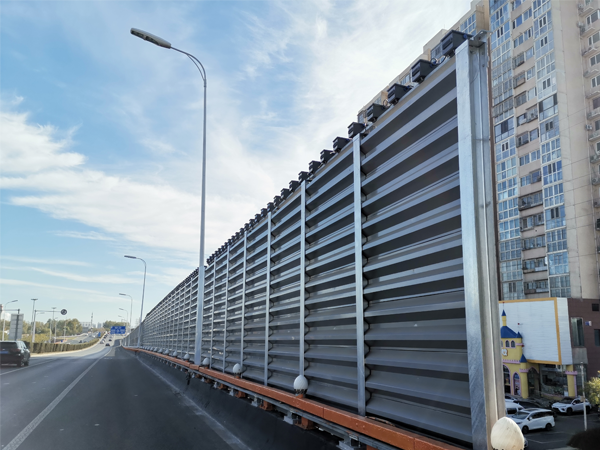
Noise barriers are commonly found along highways, expressways, and railways, as well as at construction sites. They serve to block sounds—such as wind noise generated by moving vehicles, the friction between tires and the road surface, and noise from construction activities—thereby protecting nearby residents from excessive noise. The operating principle of a highway noise barrier involves the reflection, transmission, and diffraction of sound waves. By obstructing the direct path of sound and significantly attenuating the transmitted sound energy, the impact of any residual transmitted sound becomes negligible. Given that the primary function of a highway noise barrier is to block sound, this article provides a brief overview of how the acoustic performance of such barriers is tested.
Acoustic performance testing encompasses two key parameters: the weighted sound insulation index of the barrier materials and their noise reduction coefficient.
Weighted Sound Insulation Index of Noise Barrier Materials
Testing is conducted in a laboratory environment. Before testing begins, the necessary equipment must be prepared according to established requirements. The testing facilities within the laboratory must be verified for compliance, and the microphones—along with the entire testing system—must be calibrated to ensure the accuracy of the measured sound pressure values. Because the sound transmission characteristics of a test specimen can be influenced by the temperature and relative humidity present during testing or while the specimen is being conditioned (cured), these environmental conditions must be documented in the test report. During the testing process, the sound generated in the source room must be stable and possess a continuous spectrum across the frequency range under consideration. Regardless of the method employed, the difference in sound pressure level between adjacent one-third-octave bands in the source room should not exceed 6 dB. When measuring the average sound pressure level, various methods are available; once a method is selected, microphones must be positioned according to the corresponding requirements, and the average sound pressure level is then determined based on the placement and number of these microphones. It should be noted that the frequency range of the measurement depends on the instrumentation used; for instance, if a one-third-octave filter is utilized, the measurement must cover at least 18 center frequencies. Meticulous records must be maintained to calculate sound absorption using the appropriate formulas, and the initial value for the reverberation time must be derived from the decay curve. Furthermore, background noise must be measured to ensure that the results in the receiving room are not compromised by extraneous noise. To guarantee the precision of the test results, the testing procedure must demonstrate sufficient repeatability.
Noise Reduction Coefficient (NRC) of Acoustic Materials for Sound Barriers
Tests are conducted in a reverberation chamber with a volume of no less than 150 m³. If the volume exceeds 500 m³, air absorption may hinder the accurate measurement of sound absorption at high frequencies. To achieve a satisfactory level of sound diffusion, fixed, suspended, or rotating diffusers should be installed within the chamber.
The surface area of the test specimen is determined by the volume of the reverberation chamber and the specimen's sound-absorption capacity; larger chambers require larger specimen surface areas. For specimens with low sound-absorption coefficients, the surface area should be chosen toward the upper limit of the specified range. Since fluctuations in temperature and relative humidity can affect the measured reverberation time, the test specimen must be allowed to reach equilibrium with the temperature and relative humidity conditions inside the chamber before testing begins.
During the test, the sound absorption of the empty reverberation chamber is first calculated using the appropriate formula; the resulting frequency characteristic curve should be smooth, without any distinct peaks or valleys. Once the specimen is placed in the chamber, the decay curve is measured—typically using either the interrupted sound source method or the integrated impulse response method. The interrupted sound source method involves averaging decay curves or individual reverberation time values measured at specific loudspeaker or microphone positions to obtain reliable, reproducible data. The impulse response integration method, by contrast, utilizes a sound source—or a specialized acoustic signal—capable of generating sufficient frequency bandwidth and energy; because this approach relies on a deterministic function, it is free from statistical bias and requires no averaging. Regardless of the method employed, it is essential to maintain thorough documentation. Subsequently, the reverberation times are derived from the decay curves using an appropriate analytical approach. These values are then applied to established formulas to calculate the average reverberation time of the reverberation chamber (both with and without the test specimen) and the sound absorption provided by the specimen, ultimately leading to a final assessment.
The above provides a brief overview of the acoustic performance testing of highway noise barriers. Given that noise poses systemic health risks—with prolonged exposure to intense noise potentially causing pathological changes—it has become a subject of significant public concern. Noise barriers can mitigate or even block noise to a certain extent, and they are frequently deployed along highways, railways, and at construction sites. Consequently, rigorous testing is indispensable for evaluating their true sound-insulation effectiveness.


Copyright ©
ANPING YING HANG YUAN METAL WIRE MESH CO., LTD. All Rights Reserved | Sitemap Technical Support: