sales@yhywiremesh.com
Whatsapp :+86 15027768227



In project settings such as industrial site partitioning, municipal landscaping, residential perimeter security, road hoarding, and scenic area enclosures, guardrails serve as essential structural components for ensuring safety and maintaining order. While the market offers a wide variety of guardrail types, "bent" guardrails (also known as triangular bent or 3D bent guardrails) have become a mainstream choice for engineering procurement and infrastructure construction thanks to their unique three-dimensional structure, superior stability, and versatile aesthetics. Many procurement and construction professionals appreciate their attractive appearance but may lack a full understanding of their core advantages, manufacturing details, and ideal applications. This article provides a comprehensive guide to bent guardrails, helping you avoid common purchasing pitfalls and precisely match the product to your project requirements.
I. What is a bent guardrail?
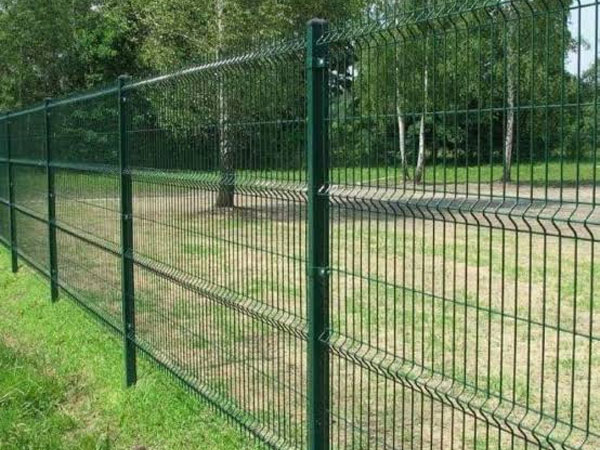
Bent guardrails—also referred to as triangular bent or 3D bent guardrails—represent an upgraded protective product that differs from standard flat-panel guardrails. Manufactured using high-quality Q235 low-carbon steel wire, they are formed through fully automated precision welding and then processed via specialized cold-bending equipment. This creates a uniform V-shaped or triangular 3D bent structure across the mesh surface, achieving structural reinforcement without the need for additional stiffening ribs. Unlike the flimsy feel of traditional flat guardrails, bent guardrails leverage the mechanical stability of the triangle to transform a flat mesh sheet into a 3D load-bearing structure. This fundamentally enhances resistance to impact and deformation, resulting in an integrated barrier that combines protection, aesthetics, and durability.
II. Four core advantages of bent guardrails that outperform standard guardrails
1. 3D structure: Doubled strength and resistance to deformation. Standard flat guardrails suffer from concentrated stress points and poor resilience, making them prone to bending or deforming under external impact or compression. In contrast, the 3D bent structure creates countless micro-support points across the mesh surface; this disperses frontal impact forces in all directions, significantly boosting overall tensile strength and impact resistance. Given identical materials and specifications, the structural stability of bent guardrails far exceeds that of standard double-wire guardrails. They resist loosening or sagging over long-term use, making them ideal for outdoor environments subject to complex stress conditions. 2. Built-in anti-climb design for maximum security: This is the core practical advantage of the bent-top fence. The triangular bend at the top creates a natural "barb-like" structure with no flat grip points, making climbing extremely difficult and effectively preventing unauthorized entry, children from climbing over, and animal intrusions. Whether for residential complexes, campuses, industrial sites, or scenic areas, it establishes a robust security barrier, making it the perfect choice for locations requiring strict containment and protection.
3. Dual anti-corrosion treatment for outdoor durability: High-quality bent-top fences undergo a dual anti-corrosion process involving hot-dip galvanizing and electrostatic powder coating. The hot-dip galvanized layer penetrates deep into the steel, sealing out air and moisture to prevent the base material from rusting. The outer electrostatic powder coating is smooth and dense, offering resistance to sunlight, rain, and acid-alkali corrosion, and withstanding harsh outdoor conditions such as heavy storms, intense sun exposure, wind, and snow. Under normal outdoor use, it remains rust-free, retains its finish without peeling or discoloration for years, and significantly reduces long-term maintenance costs.
4. Sleek, versatile, easy to install, and highly cost-effective: The fence features clean, fluid lines and a minimalist, sophisticated aesthetic—a stark contrast to the bulky, crude appearance of traditional fencing. It blends seamlessly with various landscapes without looking out of place, offering superior visual appeal. Its standardized, modular design pairs with specialized posts (such as peach-shaped or round tubular posts) and a complete set of accessories for simple assembly; no complex construction equipment is required, resulting in low labor costs and rapid installation. Compared to wrought iron fencing, it is more affordable and rust-resistant; compared to PVC fencing, it offers greater strength and durability—making it the clear leader in overall cost-performance value. III. Mainstream Applications: Meeting Most Engineering Needs
Curved-profile guardrails are highly versatile and represent an essential requirement for many projects. Key application scenarios include: Municipal Green Spaces (urban green belts, parks, and landscape barriers); Residential & Educational Areas (residential perimeters, kindergartens, and school fencing—offering enhanced safety through anti-climb designs); Industrial Parks & Facilities (perimeter zoning for factories, industrial parks, and warehouses to maintain site order); Road Traffic (auxiliary barriers for highways and elevated roads, separating pedestrians from vehicles); and Scenic Areas & Farms (boundary fencing for tourist attractions, breeding facilities, and farms—combining protection with aesthetics).
IV. Key Manufacturing Details: Determining Service Life
The quality of curved guardrails on the market varies significantly, with price differences largely stemming from manufacturing details. Focus on these three points when purchasing:
1. Welding Process: High-quality guardrails utilize fully automated high-frequency welding, resulting in solid, uniform weld points without weak spots or wire detachment, ensuring even stress distribution. Inferior products often use manual spot welding, resulting in rough joints prone to breaking or detaching.
2. Bending Precision: Standard curved guardrails feature uniform curvature, consistent spacing, and symmetrical 3D structures. Inferior versions often have skewed bends or uneven heights, which not only look poor but also cause uneven stress distribution and deformation.
3. Coating Process: High-quality powder coatings are thick and adhere strongly (resisting peeling even when scratched with a fingernail). Inferior, thin coatings flake or peel easily, leading to rust and unsightly blemishes within a short period.
V. Purchasing Guide: Avoiding Common Pitfalls
1. Avoid Blindly Chasing Low Prices: Low-priced guardrails often use substandard, thin materials and basic coatings. While they may seem cost-effective initially, they tend to rust and deform within 1–2 years, leading to higher long-term costs due to rework.
2. Select Specifications Based on Needs: Standard specifications are suitable for residential areas and home use. For industrial sites, roadways, and heavy-duty outdoor applications, it is recommended to use thicker wire gauges and higher-profile bends to enhance impact resistance. 3. Choose the original manufacturer: Direct-from-factory sourcing allows for customization of height, color, and the number of bends, as well as parameter adjustments to meet specific needs. By eliminating middlemen markups, you ensure quality and adherence to schedules, while also benefiting from services such as on-site measurements and installation guidance.
VI. Summary: Why do engineering projects favor bent-profile guardrails?
Free from flashy, gimmicky designs, these guardrails have become the "universal choice" in the industry thanks to their robust structure, reliable craftsmanship, and exceptional cost-performance ratio. With a combination of advantages—including anti-climb capabilities, impact resistance, corrosion resistance, ease of installation, aesthetic appeal, and a maintenance-free nature—they perfectly meet the protective requirements of the vast majority of civil, municipal, and industrial projects.
 Previous:
A Daily Renovation Tip | Mesh Tape
Previous:
A Daily Renovation Tip | Mesh Tape
 Next:
None
Next:
None


Copyright ©
ANPING YING HANG YUAN METAL WIRE MESH CO., LTD. All Rights Reserved | Sitemap Technical Support: