sales@yhywiremesh.com
Whatsapp :+86 15027768227



In both everyday life and engineering applications, stainless steel cable mesh is a metal product that is unassuming yet highly practical. With its open, aesthetic structure, exceptional toughness, and strong corrosion resistance, it is widely used in scenarios ranging from architectural safety barriers, landscape decoration, and garden fencing to ecological protection and venue styling.
Many people mistakenly view cable mesh as merely a simple "woven metal net," assuming there is little difference in quality between products. However, industry insiders know that the distinction between a flat, durable mesh and one that is loose and prone to failure lies not in the visible exterior, but in the precision and standardization of every step of the manufacturing process.
Unlike the simple production methods used for standard wire mesh, manufacturing stainless steel cable mesh involves a comprehensive, rigorous, and sequential process. From raw material selection and wire pre-treatment to strand twisting, precision weaving, edge reinforcement, and final polishing and inspection, every stage directly impacts the finished product's stability, lifespan, and overall quality.
01 Material Selection: Quality Craftsmanship Begins with Quality Materials
Any high-quality metal product relies on reliable raw materials. Reputable manufacturers typically use premium stainless steel grades such as 304 and 316. These materials offer structural stability and resistance to oxidation, moisture, and temperature fluctuations; they withstand harsh outdoor conditions—including intense sun exposure, heavy rain, and acidic or alkaline environments—without easily rusting or becoming brittle.
Once the raw materials arrive, they do not go straight into weaving; instead, they undergo systematic pre-treatment. Steps such as straightening, degreasing, cleaning, passivation, and drying remove surface oxide layers, stains, and impurities. This ensures uniformity in wire thickness, tension, and flexibility, laying a solid foundation for the subsequent weaving process.
02 Precision Weaving: The Core Process Determining Overall Quality
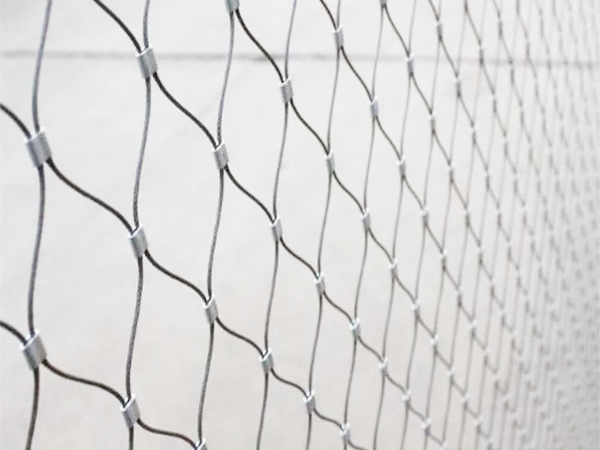
Weaving is the heart of stainless steel cable mesh production and the stage where differences in craftsmanship are most apparent. Mesh produced using inferior methods often suffers from issues such as inconsistent aperture sizes, loose tension, surface distortion, and uneven load distribution, making it prone to deformation and unraveling after a short period of use. The standardized manufacturing process employs a constant-tension weaving method. Through steps such as wire twisting, multi-strand plying, uniform interlacing, and overall pre-tensioning, every mesh opening is made uniform and regular, ensuring the entire net surface is flat, taut, and balanced in its load-bearing capacity. This approach retains the characteristic flexibility and toughness of stainless steel while significantly enhancing resistance to tension, tearing, and deformation, resulting in a finished product that is both neat and aesthetically pleasing.
03 Edge Reinforcement: Details Determine Durability
Many instances of rope net damage begin with fraying or unraveling at the edges. Edge reinforcement is a crucial step in the professional processing of stainless steel rope nets.
Once the net is woven, the edges undergo a precision locking process and are secured with specialized crimped fasteners; this effectively prevents common issues such as fraying, curling, or unraveling. Simultaneously, the tension at the net's nodes is calibrated to balance stress distribution across the entire surface, resulting in a more stable structure with uniform load-bearing capabilities that resists loosening or deformation over long-term use.
04 Polishing and Quality Inspection: The Final Line of Defense
Rigorous craftsmanship is reflected in the finishing stages. After fabrication, the net surface undergoes fine polishing to remove burrs and sharp edges, ensuring a smooth texture and safer handling. A multi-dimensional manual inspection follows, checking details such as mesh flatness, weave tightness, and edge security. Defective items are discarded to ensure that every finished product leaving the factory is of consistent, reliable quality.
In Conclusion
Stainless steel rope nets may appear simple, yet they embody genuine metalworking expertise. Quality cannot be rushed; it is achieved only through meticulous, step-by-step craftsmanship. The production of stainless steel rope nets is not a race for speed, but a test of patience, adherence to standards, and attention to detail.
By upholding every procedural step and respecting every aspect of the craft—using attention to detail to create durable, beautiful, and stable metal rope nets—we realize the true, fundamental meaning of craftsmanship.
 Next:
None
Next:
None


Copyright ©
ANPING YING HANG YUAN METAL WIRE MESH CO., LTD. All Rights Reserved | Sitemap Technical Support: